
Vande Guru Paramparaam
Sanatana Dharma: Eternal and Infinite
The usage of the word Hinduism is more prominent, but the accurate term is Sanatana Dharma
‘Sanatana dharma’ loosely translates in English as ‘eternal religion’.However the meaning is more profound and doesn’t merely represent a religion. The word Dharma originates from Sanskrit root word “dhri” which means ‘integral or essential’. Therefore, the phrase ‘Sanatana dharma’ ‘that which is essential in perpetuity to a living entity’.
Yuga is a time scale that represents an age or an era. Creation is believed to repeat on a set time cycle which consists of four Yuga as called the Chatur Yuga or Maha Yuga.The first Yuga is called Satya Yuga or Krita Yuga which is said to last for 17,28,000 years. Next is the Treta Yuga which lasts for 12,96,000 years. Followed by which is the Dvaapara Yuga and it lasts for 12,96,000 years. Finally, the KaliYuga lasts for 4,32,000 years. The Chatur Yuga or maha Yuga thus amounts to 43,20,000 years. These repeat cyclically and indefinitely. Currently we are in the 5122nd year which is in the first phase of KaliYuga.

Vedas
Vedas encompass volumes of texts and scriptures that give us extensive insights on dharma. Vedas are the primary reference point of Sanatana dharma and are therefore called as ‘Pramaanam’ (Truth). Religions that were founded based on extensive knowledge provided by Vedas are called ‘vedic religions’ and Sanatana Dharma qualifies as one. It is pertinent to note that Jainism and Buddhism that were born in India are Non-vedic religions.
Why were the Vedas never written down?
The Vedas were earlier known as ‘Shruti’ because they revealed knowledge in the form of sound waves, which the ‘Rishis’ heard and repeated. This revealed knowledge was preserved for millions of years by reciting – hearing – repeating – memorizing but never written down.
It is said that in the first three Yugas, the occupants of this earth had longer life span, greater strength, abilities, vision, memory etc. However, these qualities diminished greatly in the Yugas that followed. In KaliYuga, it became impossible to memorize the entire Veda.
A great sage called ‘Krishna Dvaipayana’- better known as Veda Vyasa- who was the son of sage Parasara and descendent of sage Vashistha- compiled the Vedas by arranging them in a cohesive order.

‘Vyasa’ in Sanskrit means split, divide, compile, arrange. A gigantic piece of knowledge was divided into four smaller parts as RIG, YAJUR, SAMA and ATHARVA Vedas. These Vedas were then written down in the Sanskrit language and each Veda was then allotted ‘Rishis’. The rishis would have great command over the Vedic scriptures and would serve as an authority of that Veda. As time went by, more rishis brought subdivisions in each Veda as Shakha and Sootra for easy adaptation.

What is Guru-parampara ?
As discussed earlier, as we move from one Yuga to another, there is deterioration in quality of life. It is said in Bhagavad Gita by Krishna Paramatma that he will manifest into various Avatars to protect the righteous, destroy the wicked and thereby re-establish Dharma. However, the embodiment of avatars purely depends on the requirements of a given Yuga.
The present day KaliYuga does not require the avatar to destroy gigantic monsters or beasts but to spiritually enlighten people to seek Jnanam (knowledge) and attain Moksha (free themselves from cycles of birth and death). Therefore, the Paramatma manifests himself in the form of a guru/acharya.

Veda also means ‘knowledge’, and Sage Vyasa who was master of all Vedas is revered as the first Guru. The lineage of master-disciple, i.e., ‘Guru Parampara’ is documented in scriptures as
NARAYANA-BRAHMA-VASHISTHA-SHAKTI-PARASARA-VYASA-SUKACHARYA-GAUDAPADA-GOVINDA BHAGAVAT PADA- AND HIS DISCIPLE-ADI SHANKARACHARYA.
Jagatguru Adi Shankaracharya
Jagatguru Adi Shankaracharya was a great proponent of ‘Advaita Vedanta’. ‘Advaita’ means non-duality. The central idea being that Atman (Inner self ) is the same as Brahman (Supreme Entity) and not different. The ‘jagat’ or creation is ‘maya’ or illusion manifested from Brahman.
The greatest service that Sri ADI SHANKARACHARYA rendered to our dharma is amalgamating the six distinct branches of Sanatana Dharma viz., Shaivam, Vaishnavam, Saktam, Koumaram, Ganapatyam, and Souram (Sun) and removing the animosity among the practitioners by advocating the Advaita Philosophy.
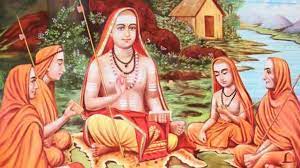
He was also instrumental in eradicating violent religious practices such as human sacrifice practiced by the ‘Kaapalika’ branch (which has no religious sanction in the scriptures). Adi Shankaracharya traveled the whole Bharata desam thrice in his 24 years of missionary life. He preached Advaita and argued with the other schools of thoughts, defeated them intellectually and reestablished the Veda, Aagama, and Vedantic riches of Bharatadesam. He regulated the practice of personal worship, temple worship and attaining vedantic knowledge through innumerable books and commentaries. He established four Mutts in four corners of the Bharat and ascended Sarvagna Peetham at Kanchipuram 2500 years ago.
All these mutts are still in existence at Sringeri, Dwaraka, Puri, Badrinath, and Kanchipuram with an unbroken line of Shankaracharyas guiding the world.
Sri Maha Periyava Charanou Sharanam
 JAGATGURU SANKALPAM